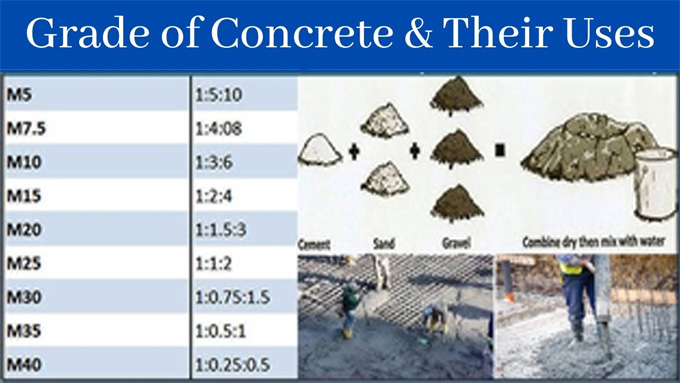
Different types of Concrete Grades and their uses
Discuss the grade of concrete used in the construction work
The grade of concrete refers to the strength and composition of the concrete, and the minimum strength of the concrete will be achieved after 28 days of the curing process. The grade of concrete is understood in measurements of MPa, in which the M stands for the mix and the MPa refers to the overall strength of the concrete. The grade of concrete has been defined in ascending numbers of 5, starting at 10, and helps to show the overall comprehensive strength of the concrete.
The right grade of concrete has been achieved by selecting suitable ingredients and their appropriate quantities. In this context, the proportion of the concrete ingredients depends upon the characteristics of those concrete ingredients. In the concrete grades, the right proportion of water, cement and aggregates has been used, which helps to form a paste and helps to bind the aggregates.
To achieve the right grade of concrete, the following factors should be considered, which are:
- There should be the right ratio of cement paste to the aggregates.
- There should be the right ratio of water and cement in the cement paste.
- There should also be the right ratio of fine aggregate and coarse aggregate in the concrete mix.
- Any kind of admixtures can be used in the concrete mix to achieve the desired quality of the concrete grades.
What is the importance of choosing the right types of concrete grades in the construction project?
Choosing the right types of concrete grades is important for the construction design project. The selection of the right grade of concrete depends on several factors. The expected loads and the stresses on the concrete structure, as well as the local climate conditions, influence the selection of the grades of concrete. In the case of the specific applications, for example, the construction of roads or industrial facilities, the selection of the grades of concrete has varied.
In the case of the construction workers opting for domestic constructions, the M20 and M25 concrete is appropriate. In the case of the road construction, M30 concrete has been preferred. On the other hand, for the heavy commercial constructions, the M35 and M45 concrete has been used because of its high durability.
The right grade of concrete also plays an important role in influencing the durability of the building structure. The right grade of concrete helps to ensure that the slabs do not crack early, the walls of the construction structure remain strong, and the plaster does not peel off.
In the Indian climate conditions, the moisture content and temperature changes will affect the buildings. In this context, it is necessary to know the right concrete grade, which will be suitable in these weather conditions. Thus, the selection of the right grade of concrete helps to reduce the maintenance costs and repair costs of the building.
Discuss the different types of concrete grades
Ordinary concrete grade
The ordinary grade of concrete generally has low comprehensive strength, ranging between 1450 and 3200 PSI. These types of concrete grades have been used in non-structural constructions. The examples of the ordinary grade of concrete are:
- M10
- M15
- M20
Standard concrete grade
The standard grade of concrete possesses better comprehensive strength as compared to the ordinary grade of concrete. This type of concrete grade has been used in the construction of girders, high-tensile beams, slurry pits and loading bays. The examples of the standard grade of concrete are:
- M25
- M30
- M35
- M40
High concrete grade
This type of concrete grade has come with the PSI strength ranging between 6525 and 9425. The high grade of concrete has impressive strength and durability, so it has been used in the construction of high-end structures, for example, bridges, dams and other structures. The examples of the high concrete grades are:
- M45 to M65
Learn details about the uses of each type of concrete grade
Uses of M10 concrete
The M10 concrete is suitable for slabs, pathways or other non-structural areas, in which the high strength is not a primary concern.
Uses of M15 concrete
The M15 concrete is appropriate for sealing floors and also for road construction. The M15 concrete helps to provide a good balance between the workability and strength of the concrete, which helps to make it versatile for different applications.
Uses of M20 concrete
The M20 has been used in residential projects. It has been used in garages, flooring and sheds and helps to provide adequate strength for the typical household needs.
Uses of M25 concrete
The M25 concrete has been used in the foundational work and reinforcing walls due to its higher compressive strength, which makes it popular in construction projects.
Uses of M30 concrete
The M30 concrete has been used in road construction works and other projects which require resistance to adverse weather conditions and heavy traffic conditions.
Uses of M35 concrete
In the case of the commercial building walls and external structures, the M35 concrete has been used because of its excellent strength and uniformity.
Uses of M40 concrete
The M40 concrete has been used in the foundations and beams due to its higher strength and durability. It has also been used in septic tanks as it provides resistance to chemical corrosion.
Uses of M45 to M65 concrete
The high-grade concrete, which ranges between M45 to M65, has been used in substantial structures, like factories, dams and bridges.
Understanding the proportioning method of concrete
Different methods have been used to decide the proportion of the cement, sand and aggregate in the concrete mix, which are as follows:
Arbitrary Method
In this method, the ratio of concrete, sand and aggregates has been chosen arbitrarily, and the water quantity in the cement paste has been adjusted per the desired workability.
Maximum Density Method
In this method, the concrete mix has been generated by proportioning its aggregates in a way that the heaviest weight for the same volume produces the densest concrete.
Fineness Modulus Method
In this method, the coarse and fine aggregates are sieved through Indian Standard (IS) sieves of different sizes.