What you need to know about Concrete Mixing Ratios
The concrete mix ratio helps to represent the proportion of the components of the concrete mix, including cement, aggregate, sand and water. The proportions of the materials in the concrete mix ratio help to determine the comprehensive strength of the concrete, the workability of the concrete and also the durability of that concrete mix.
The concrete mix ratio is essential to achieve the desired characteristics of the concrete mix, which helps to ensure that the construction project will meet the safety and performance requirements. Different types of concrete mix ratios have been used for different types of construction parts, for example, foundations, floors and beams.
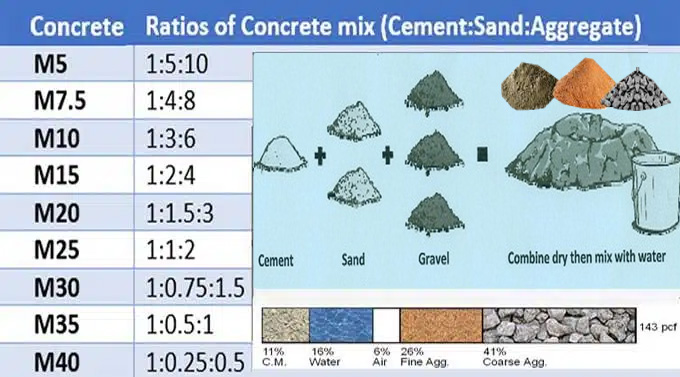
Concrete mix ratio table
Here is the concrete mix ratio table, which represents different grades of concrete mix with its respective ratios of cement, sand and aggregates:
The grades of the concrete mix |
Concrete mix ratios (Cement:Sand: Aggregates) |
| M5 | 1:5:10 |
| M7.5 | 1:4:8 |
| M10 | 1:3:6 |
| M15 | 1:2:4 |
| M20 | 1:1.5:3 |
| M25 | 1:1:2 |
| M30 | 1:0.75:1.5 |
| M35 | 1:0.5:1 |
| M40 | 1:0.25:0.5 |
Discuss the different types of concrete mix ratios
Nominal Mix Concrete
This type of concrete mix is the basic mixture of concrete, which has been used for simpler and less demanding construction projects. In this concrete mix, the ratio of the cement, sand and gravel is about 1:2:4 or 1:3:6, which has been typically used for the non-structural components, for example, small floors or walkways. This type of concrete mix ratio helps to ensure that the concrete mix has standard strength and is perfect for meeting the needs of general construction, where high durability is not the priority.
Standard Mix Concrete
This type of concrete mix refers to that concrete mix whose proportion has been defined by codes or standards, which helps to achieve a specific strength and durability of the construction structure. In the standard concrete mix, the ratio of the materials is about 1:1.5:3 or 1:2:4. The standard mix of concrete has been used to construct structural elements, for example, pillars, beams, and different types of slabs. While preparing this type of concrete mix ratio, greater precision in mixing concrete is required to support the significant weight and stresses.
Design Mix Concrete
This type of concrete mix ratio has been tailored for the high-strength requirements, in which the exact ingredients and their proper amounts have been calculated on the basis of the specific needs of the construction project. The design mix concrete has been designed scientifically, with the help of the software and calculations, which helps to achieve the desired properties of the concrete mix, including high compressive strength, increased durability and specific workability. The design mix concrete has been used in complex construction projects, for example, high-rise building structures or heavy-load bearing structures.
High-Strength Concrete Mixes
This type of concrete mix ratio has been designed for infrastructure projects, such as bridges or high-rise building structures. The high-strength concrete mix helps to achieve comprehensive strength and often helps to incorporate supplementary materials like silica fume or fly ash to enhance its performance.
Learn about the concrete proportioning method
The concrete proportioning method helps to achieve the desired volume of the concrete mix by ensuring that the concrete mix suits the specific construction needs.
Arbitrary Method
This concrete proportioning method has been used for small-scale projects, in which set rules and past experiences have been used to determine the mix proportions of the concrete. In this conext, the standard arbitrary ratio is about 1:2:4 for cement, sand, and gravel.
Fineness Modulus Method
This method focuses on the particle size of the aggregates to determine the best concrete mix. This concrete proportioning method helps to calculate the fineness modulus (FM) of the sand that has been used in the blend. This method helps to adjust the proportion of the sand and gravel to achieve the desired workability and consistency.
Maximum Density Method
This concrete proportioning method helps to create a concrete mix ratio, which provides the highest possible density and leads to higher strength and durability of the concrete. The ratios of the different-sized aggregates have also been adjusted with the help of this concrete proportioning method, which helps to minimise the voids in the concrete, as well as enhances the density of the concrete.
Discuss the significance of the concrete mix ratio
Ensuring the structural integrity of the construction structure
The concrete mix ratio significantly impacts the comprehensive strength of the concrete, which can be a critical factor in resisting loads and failure.
To get more details, watch the following video tutorial.
Video Source: Civil Engineering
Optimising project costs
The accurate concrete mix ratio helps to minimise the excess material used. This cost optimisation feature is necessary as overuse of the concrete mix can lead to unnecessary expense, and underuse can lead to the structural failure of the construction project.
Enhance workability
The adjusting concrete ratio provides significant impacts on the concrete’s workability. The higher water content in the concrete mix increases the workability of the concrete but may weaken the concrete mix.
Provide resilience against environmental conditions
An accurate concrete mix also helps to improve the resistance of the concrete to freezing, thawing and chemical attacks, thus helping to ensure the longevity of the concrete structure.