

Benefits and design of RCC coupling beam

Coupling beam stands for a lateral force resilient component of a structure. This article provides detailed information on Types, advantages and design of coupling beam according to ACI 318- 11.
Coupling beam is mostly used if two shear wall or any other components are integrated for the purpose of resisting lateral loads. As a result, it reduces overturning effect and enhances complete stiffness of a system.
Besides, if coupled beam is divided in perfect ratios over second floor of building, plastic hinges are produced which are dependent on same rotations at the beam end over structure height simultaneously.
Thus input energy dissipation is allotted over the height of the structure in the coupling beams rather than focusing mostly in the wall piers of the first story.
So, the primary objective of coupling beam is to dissipate energy and enhance rigorousness and strength of the lateral load system of the structure.
Favorite coupling beam performance is obtained when it is designed to be adequately strong and stiff. If the design of coupling beam is sufficiently powerful and stiff, optimal performance is achieved. Moreover, coupling beams should have been produced prior to wall piers, exhibit ductile behavior, and possess considerable energy absorption characteristics.
Coupling beam should be properly designed so that over coupling and under coupling is not occurred, so the former would transform the system to act as a single solid wall with small frame action and the latter will make the system to behave like two parted walls.
Types of Coupling Beam used in Structure - Two types of coupling beams are generally utilized in structure:
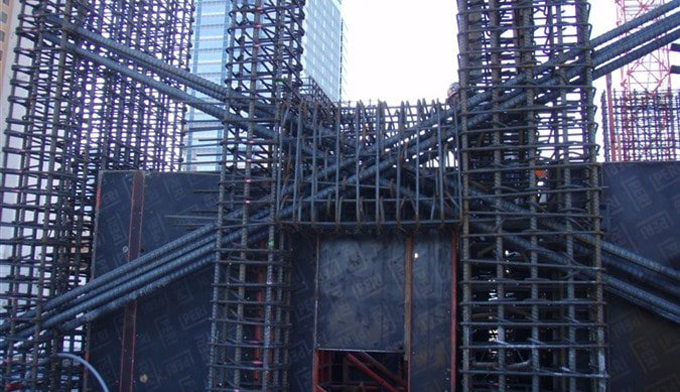
Image Courtesy: theconstructor.org
1. Conventionally reinforced concrete coupling beams
2. Diagonally reinforced concrete coupling beams
Conventionally Reinforced Concrete Coupling Beam: This type of coupling beam is identical to normal reinforced concrete containing bottom and top reinforcement besides shear stirrups. It is used when the beam is quite lengthy corresponding to its depth.
These types of beams produce moment hinge at its ends and failure type becomes ductile failure.
To read the complete article, go through the following link theconstructor.org
