|
Cost estimation can be termed as a well-devised forecast of the possible construction cost of a specific building project. A detailed cost estimate presents information to owners, architects, and builders about the facility and the project budget throughout the design phase.
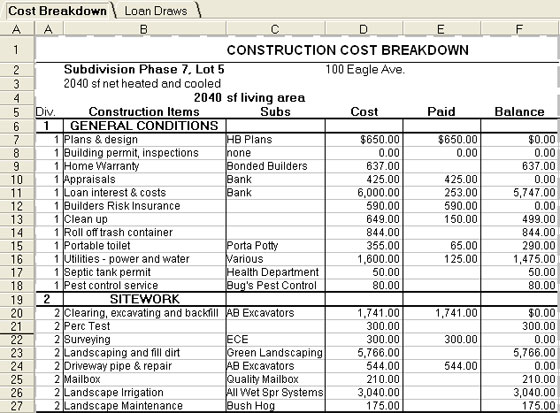
A cost estimate should incorporate all the items to be included in the general contractor’s bid. A standard format is applied to break down the items for preparing the cost estimate. The cost of each item is established from a database of up to date construction cost information.
Accurate cost estimation plays a key role in construction projects that leads to better decision making. There are several methods available to prepare the estimate of a project. These methods are based on the project’s scope, estimating purpose and estimating resources.
Parametric cost models
Under this method a parametric model is applied in which costs are forecasted based on project characteristics (parameters) in a mathematical model. Here models are developed from historical cost data based or from building a model scenario on similar systems or subsystems. Models can be simple (for instance, with the cost per square foot to estimate the total cost of building a home) or they can be complex (for instance, applying several factors to estimate the total cost of home construction, for example the number of floors, windows, and doors).
Statistical analysis is performed on the data to discover connections between cost drivers and other system parameters, for example design or performance parameters. The analysis creates cost equations or cost estimating relationships to be utilized independently or grouped into more complex models.
Bottoms-Up method
This method is applied at the time of progression of level of detail with the advancement of project. Under this method a work statement and set of drawings or specifications are utilized to “takeoff” material quantities necessary for executing each separate task achieved in completing a prearranged operation or generating an equipment component. From these quantities, direct labor, equipment, and overhead costs are derived and added. The contractors always organize this type of estimate to support their proposal bid process. This entails with a detailed WBS and pricing out each work package making up the project.
Top-down estimate
It is subsidiary technique that starts with work breakdown structure (WBS). To get a top down estimated schedule the estimator has to break down the activity and set up linkage between activities. It is applied once a good overall estimate is ascertained for the project and the method is sub-divided down through the layers of the work breakdown structure.
A top-down estimate facilitates a project manager to obtain a very similar project’s budget, work some financial math magic and get a rational budget for the current project.
Top down estimating is primarily applied in construction projects to provide a quick estimate where the prerequisites are more or less static, and there aren't too much unknowns. This method can also be applied for small software projects.
Top-down estimates employ rules of thumb, parametric models, analogies, or cost estimating relationships (CERs). CERs based on historical experience that can present data involving the cost to build up a source line of software or the cost per square foot for a building construction project.
This method estimate the size (duration and cost) and risk of a project (or phase) by looking at the project as a whole and matching it with the similar projects executed in the past.
|